
About Catherine McAuley

Catherine McAuley: The Spirit We Honor
Catherine McAuley never set out to become a Sister. Her heart and vision were focused on providing educational, religious and social services for women and children vulnerable to exploitation and entrenched poverty. Catherine cared as deeply about spiritual formation as she did about meeting the material needs of those she served. She rekindled dignity and a sense of God’s nearness in people who felt forgotten, empowering them to imagine new possibilities for their lives and to deepen their faith.
Having built and opened the House of Mercy in 1827 with her inheritance, Catherine, already in her fifties, which was somewhat elderly in that era, had the courage to respond to what she felt called to do. In 1831, to ensure the continuation of her charitable work, Catherine and two of her companions entered the Presentation Convent in Dublin to begin their formal preparation to become religious sisters.
On December 12, 1831, Catherine McAuley, along with two companions, made their Profession of Vows. On that day, the first Convent of Mercy at the House of Mercy was blessed by the Bishop and marked the founding of the Order. A month later, seven of Catherine’s helpers were received as the first Mercy novices. These young women had worked with her from the beginning.
The sisters, who were without the usual strict enclosure of women religious, inspired others to see and meet local needs, and the new Institute began to spread rapidly. The humble beginnings became an international congregation of Sisters of Mercy.
Visit here to learn more about Catherine’s life
- A Great Woman and Her Time - An eight-part, two-hour series by historian Graham Peck in concert with WXAV (88.3), the radio station of Saint Xavier University (2018).
- The Circle of Mercy - The Circle of Mercy is a collection of songs on Mercy themes that have been written by Mercy Sisters and Associates from different parts of the world. These are songs about Catherine (Mother of Mercy; Suscipe of Catherine McAuley, Catalina McAuley) and songs about justice (Women Speak Justice); songs of the Mercy charism (Mercy Seed, Triple Amen) and songs of union (We Are One; Circle of Mercy).
- Catherine McAuley and the Following of Jesus Christ Today - Presentations by Mary C. Sullivan, RSM, at Baggot Street during Wellsprings 2012. Catherine McAuley still has very much to say to us, especially today. She took Jesus' invitation, "Follow me," very seriously. What she tried to be and do as she strove to "resemble Jesus Christ in some one thing at least" speaks to the heart of our Mercy life.
The Spirit of Catherine Today
Find below a series of articles written by Sr. Anne Curtis, RSM, about "The Spirit of Catherine Today." The writings explore how the life and vision of Sisters of Mercy Founder Catherine McAuley continues to shape the work of Mercy by the Sea and deepen our commitment to solidarity, service and mercy.
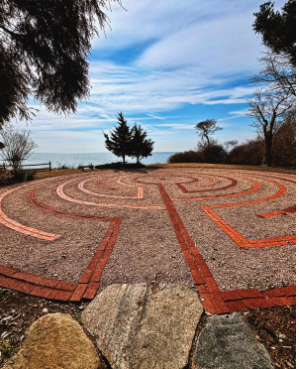
Mercy by the Sea labyrinth by AliceJuneThompsoniPhonephotographer
God's Spirit is Never Confined to One Path Alone
We associate Catherine McAuley with the rich traditions of the Catholic faith and the charism of Mercy. Yet one of the lesser-known influences on her life came from an unexpected source—the Quaker community of early nineteenth-century Dublin.
When Catherine was nineteen, her mother died and she went to live with Protestant relatives. In bitterly sectarian Ireland, her Catholic faith was often ridiculed as superstition. A few years later, she became housekeeper for William and Catherine Callaghan. It was here that the Quaker connection took root, as Catherine Callaghan had been a lifelong Quaker.
During her years in the Callaghan household, Catherine encountered values of simplicity, integrity, quiet reflection and generous hospitality that left a lasting impression. These experiences helped shape the leader she would become, reminding us that God often forms us through people whose faith and values enrich our own journey.
In the Quaker tradition, decisions were entrusted to quiet waiting and prayer rather than argument. "The way will open," they would say. Catherine seems to have absorbed this patient trust in God's guidance. Though the language differed, the practice of discerning God's will was strikingly similar.
The Quaker influence can also be seen in the way Catherine founded a community that united contemplation with compassionate action. She insisted that prayer must always lead to concrete acts of mercy, echoing the Quaker conviction that faith is revealed in daily life.
Perhaps the strongest bond between Catherine and the Quakers was their shared concern for people who were poor. Quakers were known for welcoming the stranger with simplicity, dignity, and equality. Catherine embraced these virtues and wove them into the fabric of Mercy spirituality, making hospitality and compassionate response to need a sacred ministry where every guest could encounter the presence of Christ.
Catherine's openness to the wisdom she found in another Christian tradition reminds us that God's Spirit is never confined to one path alone. Her life calls us to listen with humility, discern with prayer, and embody mercy through lives of generous welcome and compassionate service. This is the legacy we are invited to live today.

A retreatant’s photo taken at Mercy by the Sea on June 23, 2026.
The Heart of Catherine's Life: Friendship, Affection and Mercy
For Catherine McAuley, relationships were at the heart of her life and spirituality. She believed that love of God was expressed through a practical love of one’s neighbor and possessed a remarkable ability to connect with others on a deeply human level.
Catherine viewed friendship as an essential, life-giving gift. She believed it renewed and sustained the human spirit, once writing that life would be “inconceivable and intolerable” without friends to guide, affirm and console us. Reflecting on friendship, she said: “It will be a source of great happiness — for which I thank God — pure heartfelt friendship which renews the powers of mind and body.” She relied deeply on the companionship of trusted friends.
When Catherine could not be with others, she wrote letters. Through them, she inspired, encouraged, and maintained meaningful connections. Her correspondence reveals the deep affection she held for others. Her favorite sign-off, “Affectionately yours,” reflects the warmth that characterized her relationships.
Catherine’s love was evident in her concern for others in every aspect of their lives. Following her example, may we cherish those we love, grieve with them in their sorrows, rejoice in their accomplishments, forgive their weaknesses and gently encourage one another.
In a time that can seem harsh, divided, and disconnected, Catherine reminds us of the enduring human gift of affection and genuine relationships. Her life teaches us that heartfelt concern for others has the power to heal wounds, bridge differences, and restore hope. By fostering relationships grounded in compassion and mercy, we continue her legacy.

Spiritual Director Marion Scranton, SC dancing with MBTS Facilitator Carmel Boyle during the singer/songwriter's “The Music of What Happens,” a music-inspired retreat. (June 2024) Photo credit: Karin Nobile
Dance Every Evening: The Playful Spirit of Catherine McAuley
Cheerfulness and humor aren’t always associated with “saintly” people. Yet, Catherine McAuley was widely known for her playful and joyous spirit, even amid the significant losses and hardships in her own life. Known for her "mirth," she used humor to diffuse tension and build community. She did not take herself too seriously and, able to laugh easily, she often used witty anecdotes to bring light to difficult situations.
Catherine frequently wrote playful verses, using humor to encourage others. She delighted in fun, and her Sisters often recalled her cheerfulness and unpretentious manner. Across the top of one of her letters, she wrote in large letters: “Dance every evening.” When an overly serious mood began to dominate a community, she would step in with letters urging a healthy dose of nonsense and play.
After visiting the community in Tullamore, Catherine wrote to a new postulant describing plans for her next visit: “We will set up for a week what is called a Nonsensical Club. I will be president, you vice-president, and Catherine can give lectures as professor of folly.” This snippet reflects Catherine’s belief that "contemplation in action" included joy and a light-hearted spirit to prevent burnout, balancing hard work with fun.
The playfulness, humor and warmth flowed from a deep well of faith, love and gratitude within Catherine, the true source of her joy.
Today, Catherine’s example invites us to embrace that same spirit. In a world often weighed down by stress, division and seriousness, we are reminded of the grace found in laughter, kindness and lightheartedness. Like Catherine, may we ease burdens with compassion and humor, and never lose the ability to “dance every evening” — finding joy not in perfect circumstances, but in the deep assurance of faith, gratitude and love.

Photo from the Artemis II Expedition (April 1-11, 2026), Credit: NASA/Reid Wiseman
Catherine McAuley and the Eighth Work of Mercy: Care for Creation
|
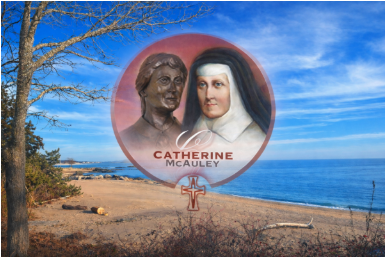
|

Image by Laura Way
Action and Contemplation
It has been said that Catherine McAuley’s greatest contribution to the world was not the congregation itself as much as the spirituality that grounded it -- a blending of a contemplative spirit and compassionate hands.
Catherine pioneered a spirituality of "contemplation in action," interconnecting prayer with direct service to those who were poor, sick and uneducated. She believed that active ministry didn’t take from one’s spiritual life but rather sustained and deepened it, understanding prayer and service as part of a seamless rhythm.
"The streets will be our cloister," Catherine said. She believed a profound inner life supported a life of service and was a way of connection with God. "No occupation," she said, "should withdraw our minds from God. Our whole life should be a continual act of praise and prayer."
The integration of contemplation and action as a way of life remains a crucial challenge today, just as it was for Catherine and her Sisters. For those engaged in service to others, contemplative time and spiritual practices are not luxuries but necessities — essential for remaining grounded in our humanity, deepening our spirituality and sustaining the inner resources needed to serve well.
Today, the Sisters of Mercy, together with associates, co-workers and volunteers, continue this legacy by ensuring that their active and often demanding lives are balanced with a deeply reflective, prayerful life. This stance of being “contemplatives in action” stands as a countercultural witness, offering a centered, grounded presence in an increasingly hectic world.

Sisters of Mercy at the Catholic Day of Action in Washington D.C. (Mackenzie Harris, Faith in Public Life)
Hospitality: Welcoming the Stranger
Catherine McAuley felt a deep call to extend hospitality, to welcome the stranger. Throughout her own life, she depended on the hospitality of others. She knew what it felt like to be different, to be a stranger in an “alien” place. Because of this, she was deeply committed to returning the hospitality she herself had received. She once said that, given the opportunity, she would buy a house and take in women and children who had nowhere else to go. When she later received an inheritance, she did exactly that--building a place to welcome women and children, taking them into her house and heart.
From this lived experience, we can see that Catherine practiced what might be called radical hospitality: an intentional way of welcoming everyone, especially those on the margins, to create a sense of belonging, safety and of being truly seen and valued. Her life reminds us that hospitality is a transformative practice that bridges the distance between self and other.
In our own time, marked by extreme polarization and the tendency to “other” those who seem different from us, this call resonates powerfully. As people of Mercy, we are called to counter this by recognizing that there is no “they,” that we are all one. Catherine McAuley lived from this awareness. Prayer was her first priority, never an afterthought. She understood that time spent in prayer and reflection cultivated a deep sense of the interconnectedness of all things. Perhaps this is a gift of our turbulent times: an invitation to more intentionally embrace a rhythm of contemplation and action.
Catherine recognized in every stranger at her door--in every person who was different from herself--the hidden presence of Christ. Mercy hospitality calls us to do the same: to see that hidden presence and to engage in ways that break down barriers, affirm dignity and disrupt societal norms. Mercy invites us to meet people where they are, to hear their stories and to offer support without demanding conformity. What if, inspired by Catherine, we insisted on radical hospitality in our own lives and communities, choosing to be a welcoming presence for the stranger in our world today?
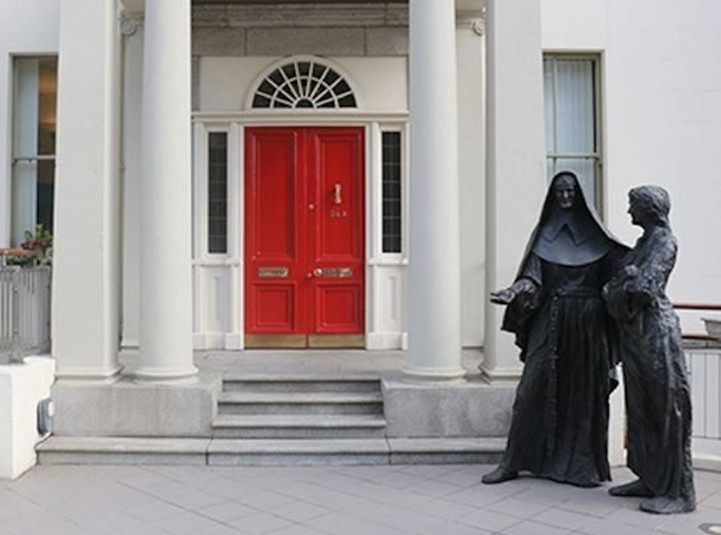
Catherine's House is a Centre of Hospitality, Heritage, Pilgrimage and Renewal -- Dublin, Ireland
The Founding of the Sisters of Mercy
Catherine McAuley never set out to become a Sister. Her heart and vision were focused on providing educational, religious and social services for women and children vulnerable to exploitation and entrenched poverty. Catherine cared as deeply about spiritual formation as she did about meeting the material needs of those she served. She rekindled dignity and a sense of God’s nearness in people who felt forgotten, empowering them to imagine new possibilities for their lives and to deepen their faith.
Having built and opened the House of Mercy in 1827 with her inheritance, Catherine, already in her fifties, which was somewhat elderly in that era, had the courage to respond to what she felt called to do. In 1831, to ensure the continuation of her charitable work, Catherine and two of her companions entered the Presentation Convent in Dublin to begin their formal preparation to become religious sisters.
On December 12, 1831, Catherine McAuley, along with two companions, made their Profession of Vows. On that day, the first Convent of Mercy at the House of Mercy was blessed by the Bishop and marked the founding of the Order. A month later, seven of Catherine’s helpers were received as the first Mercy novices. These young women had worked with her from the beginning.
The sisters, who were without the usual strict enclosure of women religious, inspired others to see and meet local needs, and the new Institute began to spread rapidly. The humble beginnings became an international congregation of Sisters of Mercy.
December 12, Foundation Day, provides Mercy People with an opportunity to reflect on the beginnings of that legacy for today. In a time when poverty, pollution and prejudice continue to ravage lives and end dreams, Mercy, rooted in faith, continues to point the direction. On Foundation Day, we look again at the life and work of Catherine McAuley to revisit the courage it takes to respond to the needs of our time, the faith it takes to follow the gospel, the hope it takes to be light in the darkness, and the love it takes to be mercy at the heart of the universe.
On this Foundation Day, let us celebrate our Mercy heritage and join in bringing compassion, justice, hope, faith and courage to all we meet.
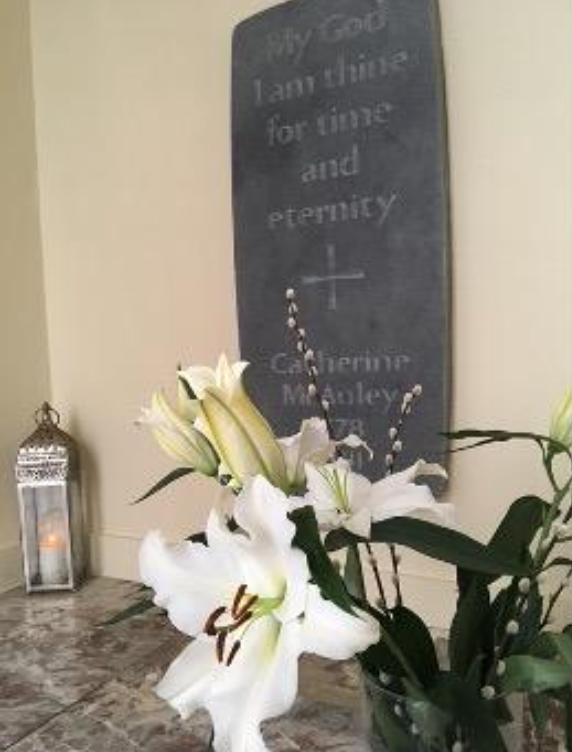
Photo of Catherine’s grave at Mercy International Centre, Dublin, Ireland
Catherine McAuley, Woman of Mercy, on the Anniversary of her Death, November 11th
Just 10 years after founding the Sisters of Mercy, on the evening of Thursday, November 11, 1841, Catherine McAuley died at the House of Mercy on Baggot Street in Dublin. Surrounded by members of her community, Catherine spent her final day speaking individually with each sister, offering them her blessing and parting advice.
Catherine's final words reflected that her heart's steadfast trust in God and the love and concern for those around her. Most often remembered from that evening was her request that the sisters be given a good cup of tea when she was gone. This simple gesture of selflessness and merciful generosity has become a touchstone of Catherine’s hospitable spirit. Because it is such a potent symbol, we continue to reflect on its meaning for us today.
What would Catherine say to us now? What “good cup” can we offer to others? Even in death, Catherine calls us to merciful action.
Let us ask her to help us reach out and offer a good cup more generously and selflessly -- to the refugees and immigrants throughout the world seeking safety, to the suffering Ukrainians, the hungry children, the victims of wars and trafficked girls. May we refuse to demonize others or contribute to division and polarization.
The size and shape of our mercy today must affect our own daily lives. It must cut into our budgets and menus. It must be collaborative, generous and courageous -- ready to give, advocate, pray and witness. It must seek to embody the spirit and generosity of Catherine McAuley.
During this month of remembrance for our beloved deceased, let us honor Catherine's legacy by asking for a share in her spirit that we may be the heart and hands of Mercy.
Rooted in Catherine’s Vision, Serving the Needs of Our Time
At Mercy by the Sea, our mission is deeply rooted in the vision of Catherine McAuley. In her time, Catherine responded to the urgent needs of her world with courage, compassion, and a steadfast belief in the transformative power of mercy. Today, her spirit continues to guide us as we offer a sacred space -- a thin space -- for all who seek rest, renewal, and connection with the divine.