
The Catherine McAuley Spirit Award

Award designed by Sister Marie Henderson, RSM
Marie Dennis is the Inaugural Recipient of
Mercy by the Sea's
Catherine McAuley Spirit Award

Marie Dennis, a longtime leader in the global Catholic peace movement, has been named the inaugural recipient of the Catherine McAuley Spirit Award. Dennis will be recognized at the Celebration of Mercy & Service benefit on Sunday, Oct. 4, 2026, at 5:30 p.m. at Mercy by the Sea in Madison.
The award celebrates an individual who embodies the enduring values of Catherine McAuley — mercy, hospitality, compassion, justice and service — and a deep commitment to the Critical Concerns of the Sisters of Mercy: immigration, racism, women, care for Earth and nonviolence. Dennis' six decades of faith-rooted peacemaking, and a life grounded in a rhythm of action and contemplation, reflect those concerns.
She is co-director of the Catholic Institute for Nonviolence, a project of Pax Christi International, where she also served as co-president from 2007 to 2019. From 1989 to 2012, including for 15 years as director of the Maryknoll Office for Global Concerns in Washington, D.C., she carried the experience of missioners worldwide into U.S. foreign policy, the World Bank, the International Monetary Fund (IMF) and the United Nations. She co-founded the ecumenical Center for New Creation and helped launch Jubilee USA, a campaign to cancel unjust debt in impoverished countries.
In 2016, Dennis was a principal organizer of the Conference on Nonviolence and Just Peace, co-hosted in Rome by Pax Christi International and the Pontifical Council for Justice and Peace. That gathering launched the Catholic Nonviolence Initiative and has helped move Gospel Nonviolence toward the center of Catholic teaching. She holds a master's degree in moral theology from Washington Theological Union, honorary doctorates from Trinity Washington University and Alvernia University, and is the author or co-author of nine books, including “Choosing Peace: The Catholic Church Returns to Gospel Nonviolence.”
Dennis' path began far from peacebuilding. As a physicist, she worked for the U.S. Navy at the David Taylor Model Basin designing nuclear submarine nose cones. Her husband's military service took the family to Guam during the early years of the Vietnam War.
When they returned to the U.S. two years later, they faced a country in upheaval amid the civil rights movement, farmworker organizing and the assassinations of the Rev. Martin Luther King Jr. and Robert F. Kennedy. “I felt as though I'd come back to a completely different country,” Dennis says. “Social movements were pointing to major, deep challenges and injustices in our society that needed attention and to which I had not been paying attention. It started me down a road of trying to understand what was going on, asking questions and getting involved in community service work.”
Such work gave her an up-close look at poverty. “It disrupted my assumptions about how we live in the world.” What she realized: “There's such a gap between people who have security and a safe place to live versus families with no security, no safe place to live, no steady income or employment.” She came to believe that “in order to really follow Jesus meant doing everything I could to move more closely to the margins of our society in order to understand what life looked like from those places.”
Dennis, her husband and their six young children moved to a 65-acre organic working farm in rural Virginia, where she also continued her growing work for justice and peace. Since 1987, she has lived at Assisi Community in Washington, an intentional Catholic community which she co-founded with Franciscan Joe Nangle and two other friends, to live simply and support each other’s work for social transformation.
Asked how people live nonviolence as a daily commitment, Dennis describes it as a spirituality grounded in the Gospel and shaped by Catholic social teaching. “Compassion, solidarity and mercy, based on love, make up the composition of nonviolence.”
Her answer to the current expressions of violence at home and abroad is one she returns to often. “It can be overwhelming,” she admits. “All any of us can do is to take the next right step faithfully, make it a hopeful step and believe we’re doing it together.”
The Oct. 4 Celebration of Mercy & Service benefit will introduce Dennis to the Mercy by the Sea community and support the center's mission as a place of rest, reflection and renewal for those who serve — embodying Catherine McAuley's belief that prayer, reflection and rest are not a retreat from the world, but the wellspring that makes courageous service possible.
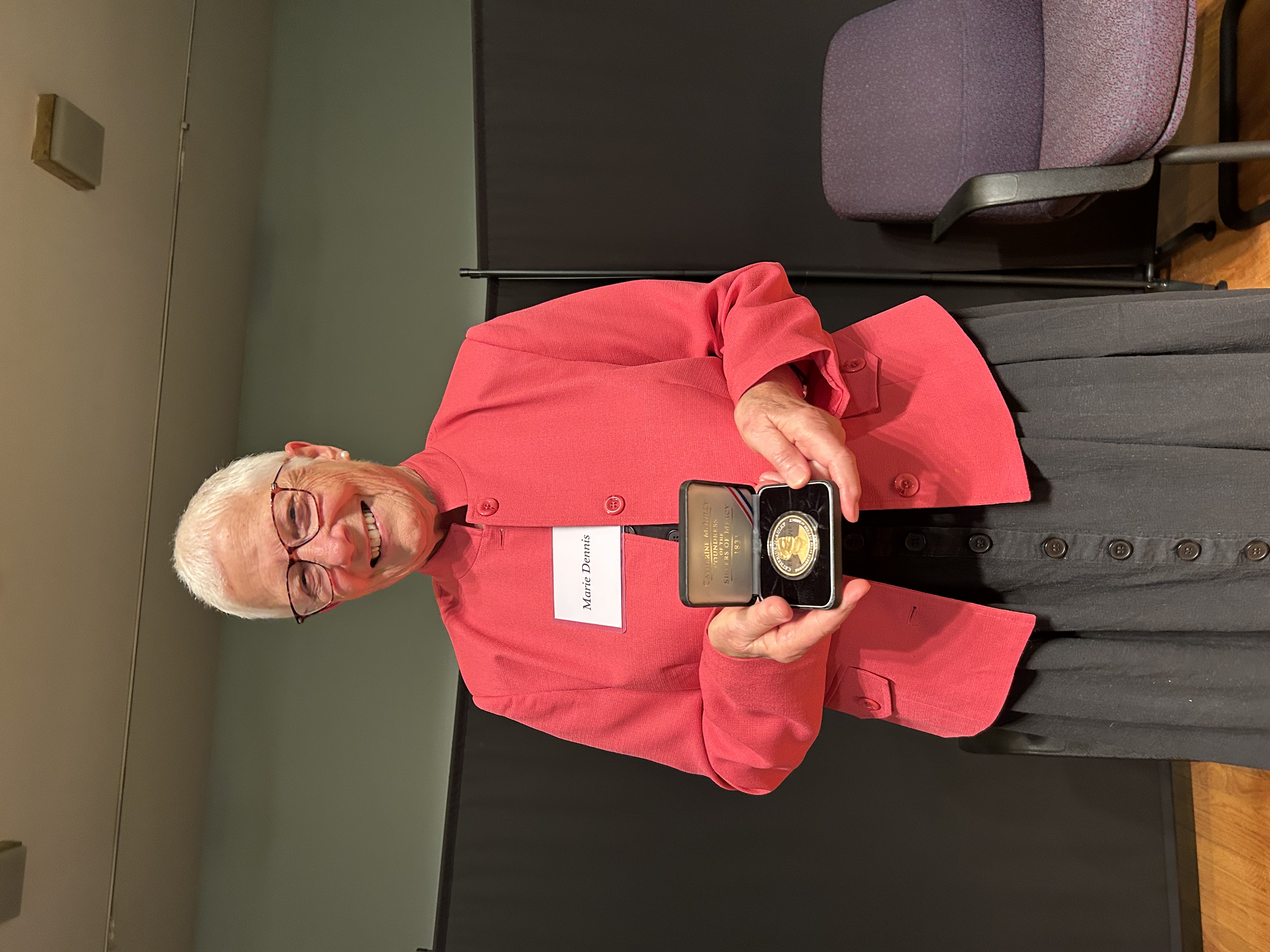
Marie Dennis Acceptance Speech
Thank you so much. I am humbled and really delighted by this recognition. In many ways the Sisters of Mercy provided a kind of ethical skeleton for me in high school (“Dare to be different,” we were told!) and have repeatedly held a lamp for me on one or another horizon toward which I was trying to move.
· As a Catholic woman, I was filled with hope when Sisters of Mercy president, Theresa Kane respectfully spoke truth to power, to the Pope himself.
· When my family was struggling with an effort to live more simply in a hungry world, the Sisters of Mercy offered an important example by selling your valuable property in Potomac, MD to live more simply yourselves and to fund housing resources for homeless women.
· When I was working at the Maryknoll Office for Global Concerns, the Sisters of Mercy Justice Team offered (and still offers) visionary leadership to the working groups and coalitions that coordinated our collective work for public policies that promoted social, racial, economic and ecological justice.
· And most recently, serving on the Mercy Socially Responsible Investment Committee, I have been awed, inspired and challenged by the brilliant , extraordinary work for justice of Mercy Investment Services.
Today is an important day – not only is it the 800th anniversary of the death of St. Francis of Assisi, but it is also the 40th anniversary of Assisi Community. Earlier we had a great Zoom call with past members of the community, now scattered around the world!
As he began his own journey, St. Francis heard a voice telling him, “Rebuild my Church,” a vocation that required so much more than a hammer and nails. In many ways the Sisters of mercy have been doing exactly that – rebuilding the Church.
Lately, I have been thinking about the complexity of my own journey – the highs and lows, the times I almost walked away, the times more recently when glimmers of hope began to seep back into my soul.
I say that especially because I have been in Rome repeatedly over the past few years interacting with the Vatican. In spite of my well-worn cynicism, I have seen real signs of hope – signs of a Church undergoing some significant repair ... small shifts in the role of women in leadership positions, a more respectful relationship with LGBTQ persons, efforts to implement Laudato Si, the synodal process itself….
Another sign of hope is a definitive shift in Catholic social teaching that is deep, interesting and challenging, Church teaching on the death penalty, the “very possession” of nuclear weapons, and the just war tradition are all in a different place than they were a few years ago, thanks to Pope Francis, Pope Leo, and a long line of peacemakers in the past century and more.
For the past ten years or so, Pax Christi International and its Catholic Nonviolence Initiative have been trying to move Gospel nonviolence to the center of Catholic teaching by asking a few basic questions:
· What if the 1.3 billion Catholics worldwide had a full understanding of the power and effectiveness of active nonviolence and the connection of nonviolence to the heart of the Gospel?
· What if we all knew how to apply nonviolent tools to defuse conflict before it became violent?
· What if the Catholic Church committed its channels of communication and diplomacy, its vast spiritual, intellectual and financial resources to promoting active nonviolence?
· What if Catholic schools, colleges, universities and seminaries integrated programs on nonviolence and just peace into their curricula, their research and their community outreach efforts?
In recent visits to Rome we have repeatedly experienced open and positive responses to our proposal that the Church recommit to the centrality of Gospel nonviolence.
We are actually beginning to imagine rebuilt Church that will model nonviolence and right relationships internally and help move our broken world from a paradigm of perpetual violence to a new nonviolent way of being - modeled on the words and witness of Jesus and the way of St. Francis!
I believe that people everywhere are tired of violence and hungry for this new world, which we are building together. We have to build it together. Pax Christi is convinced that nonviolence is the only way to do so and we are finding more and more people on every continent and in the institutional Catholic Church who are open to that possibility. Nonviolence is not the same as pacifism. It is a spirituality, a way of life, a potentially universal ethic, and a proven, often-effective approach to preventing or interrupting violence and to protecting threatened communities. It is more than an ideal. It is more than aspirational. It is, I believe, the future.
Thank you so much again. This honor belongs to a great community of communities working for a more just and peaceful world everywhere – a community that clearly keeps hope alive – including right here. Thank you!
Marie Dennis